Us vs Him
Deconstructing, The Chicago Bulls, and Holy Week


First up, my CRJ piece on Preston Sprinkle was published last Friday and I totally forgot to direct your attention to it. Here is a taste of the introduction:
“Sometimes how we believe,” writes Dr. Preston Sprinkle in Embodied: Transgender Identities, the Church, and What the Bible Has to Say, “is just as important as what we believe” (emphasis in original). Sprinkle’s conversational, friendly, and confident authorial voice is both appealing and provocative. As I read his books and listened to his podcasts, I found myself moved and compelled by the stories of so many people who have found life difficult and alienating. It took me many months to adjust my mind to the implications of his bold claim. “The content of what we say is significant,” he goes on. “We should reject lazy thinking, unbiblical theories, and convoluted illogical reasons for what we believe. But if our posture and tone don’t communicate love, the content of our ideas will be powerless.”1
Sprinkle occupies no small position in American evangelicalism. With a PhD in New Testament from Aberdeen University, over two decades of interviewing those who identify themselves by the LGBTQ acronym, books, conferences, and the NIV Upside-Down Kingdom Bible (Zondervan, 2024), Sprinkle may be considered an expert on many trending topics. He has carved out a sphere of influence most particularly, however, in the sexuality debate.
His contention, if one could possibly sum up so great a body of work, is that because sexual minorities have been so excluded from and injured by the church, it is necessary for Christians to alter the manner, the tone, and sometimes even the vocabulary of faith. The content, as he says, is “significant,” but because it has been communicated so unlovingly, many LGBTQ people have not come to know the Lord nor inhabit those spiritual communities that ought to have given them space to flourish and grow.
Read the whole thing! And here’s the podcast with Melanie:
My next project for CRJ is to read a bunch of post-deconstruction/reconstruction books to see how the Exvangelical/deconstruction movement is doing. So yesterday I sat down, and in one fell swoop powered through Tiffany Yecke Brooks’ To Rebehold the Stars: Reimagining Faith and Formation After Deconstruction. It is a breezy read, well written, engaging. Though, I confess, I found some of it a little cheesy. Every chapter, for example, starts with Letter R words, like “Reassess,” “Revisit,” “Revamp,” “Revise,” and so on and so forth. Brooks expects that many people who have deconstructed will find their way back into some kind of church, though one that aligns with their current views. The measure she offers the reader to thread the narrow way between what is acceptable and unacceptable is not truth, at least not by itself, but ways of looking at God that the reader feels are acceptable and useful. I, unhappily, did not learn anything new about those who have deconstructed their faith—it still seems like the effort to avoid Jesus at all cost, and to blame all Christians while doing it. This is not the ‘I just don’t go to church anymore because I don’t like it’ person who I meet every day. This is the person who has been part of a “movement,” a conscious and purposeful exit from the church because the church was very bad, Rev. Karla style.
Throughout, Brooks often refers to the need to let go of Christian “programming.” Not the kind where you go and open the bulletin and find out what the “program” is going to be that morning, but the circumstance where you, in your youth, are taught things, or somehow absorb various ideas into yourself. You might have been taught as a child that the Bible is the Word of God, and that you had to be modest and chaste, and that you should put the needs of other people before your own. The only path to happiness, someone might have said, is to “trust and obey.” These kinds of messages, for many people, became the “programming” that had to be deconstructed and dismantled when they grew up.
The curious thing, as I read, was that Brooks seems to assume that many who have deconstructed will return to some kind of church. But the church will have to be a place of safety where all the so-called “programming” will not impinge on the spiritual flourishing of the individual. And this, for me, is a conundrum, because the whole point of the church is that you are so bound to the Lord Christ that you gradually become bound to the other people. You don’t really get to organize and govern the spiritual communion that grows between God and his people. It is something that he does—sometimes through solace and comfort, sometimes through division and trouble.
And as I was reading, a line from Scripture that is hard to understand, one that appears in one of those letters of John at the very end, popped into my head. It is usually quoted when heretical teaching sweeps across the church and a lot of people go away, or the person trying to push the new teaching flounces off to form a sect of some kind. It is the “they went out from us because they were not of us,” bit. It is a tragic line that haunts me and makes my stomach seize up. You—or perhaps I should just cut to the chase and say “I,”—had been going along thinking that we both were, together, “of” Christ. And yet now whatever semblance of communion we once shared is destroyed because the person just isn’t there anymore.
Tiffany Yecke Brooks used the word “programming” so often that it did finally occur to me that people who go through the process of deconstructing their faith will not ever be able to fully reconstruct something, because the assumption of faith requires a Christian body, if not to be a part of, at least as a foil. The deconstructor needs the ghostly existence of their former “faith communities” always there in the background, providing reasons to be angry and sad. They deconstructed because they had not actually constructed anything in the first place. They were given a repository of information about God, they were offered ideas and thoughts and prayers, and some of it sunk in and became a way of thinking about the world, but as soon as the world itself came to think in a contrary way, because that “programming” was not a personal relationship with Jesus, they found it less psychically painful to be outside of the church than in. They “went out” because they “weren’t in.”
Some of these people then look back at the church and say something like, “Those people are too much concerned with ‘us versus them.’” I read this line several times in To Rebehold the Stars. Brooks is trying to help people find a church where they won’t feel the painful division of the church from the world. And this also is a tragedy, because people like me are not over here in the church, looking out at the world with animosity. I want everyone to be in the church. But I know that many people do not want to come. And I can’t do anything to force them. And worse, a lot of things that the people in the church believe are perceived painful and upsetting.
Take, for example, the enormous outcry over a famous person (though I hadn’t heard of him) being removed from his basketball job. Here is a tweet:
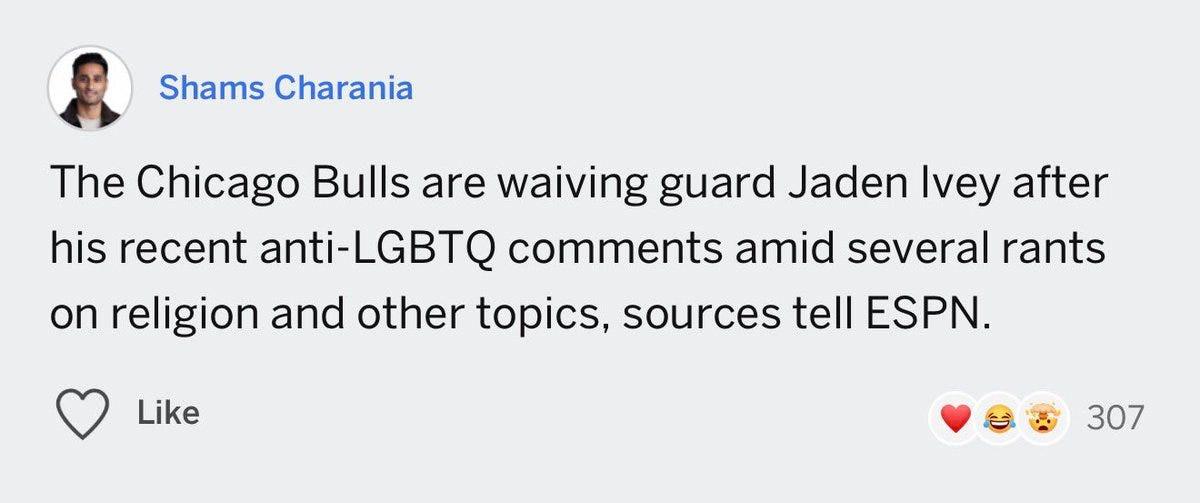
I went and watched the viral video:
Is this “programming?” Has this young man suddenly been handed a script? I would not expect that words like “righteous,” used in their Christian sense, would form part of the usual vocabular of a basketball franchise. Only God can see the heart, and he is the one who creates so many of the divisions that make me the most uncomfortable.
The only thing I know to do about this, especially in a week where I will go around doing small tasks trying to make the worship of Christ a meaningful and spiritually rich time for other people, is to be surprised again by how Jesus was the one from whom all the people—every one of them—went out. Not only were they not of him, they were not in him.
Of course, some of them came back. The 11, and the women, and eventually the 120 in Jerusalem and the 500 in Galilee, until finally the whole world heard about the Lord Jesus and his death and burial and resurrection and ascension. But in that dark day, and the week leading up to it, the ever narrowing, the total division of God from his own creation is quite breathtaking.
But by enduring such total alienation, what happened was that you and I were given the chance to draw near, to find Jesus and be found in him. There is no greater, more sure, more blessed kind of belonging than that.
I’m sorry I must rush—got so much to do. I’ll put the Livestream up shortly when I get a minute to think straight. Have a good day, even, perhaps, if you don’t feel up to it.
I hadn’t really thought about that before, how the passion week is a story of His circle getting smaller, more and more walking away, even running, until it’s just Him standing on Pilate’s pavement, bloody and alone. Then after the resurrection, they trickle back. First the women, then Peter and John, then the 12, the 120, then at Pentecost it…explodes. Like a singularity that just bursts and brings a new world.
I think we need to deconstruct the euphemism "deconstruct." After all, it was a wiggle word ever since Derrida invented it. He apparently spun it off of Martin Heidegger's concept of "Destruktion"... and that's what it is. Deconstruction is nothing but Orwellian double-speak for destruction. That's a known thing...
But the more I watch, the more I am also beginning to believe that deconstruction might actually be something else. More and more, deconstruction is more about the construction of something entirely new, a new religion somewhat inside the auspices of Christianity, but really something else.