

Goodness this autumn has been golden and sublime. The blustery weather is finally picking up and the leaves are whirling and it seems like maybe the time has come to dig out a hat and a coat. But before I think about that, David Roseberry had another great piece in his series about low morale in the ACNA yesterday. It is called “Getting Our Wind Back: Seven Ways to Restore Morale in the ACNA; We have spent enough time talking about what is wrong. Here are some things we can actually do.” He writes that:
Institutional problems have a way of slipping inside us. We become angry. Suspicious. Cynical. We assume motives. We begin sorting brothers and sisters in Christ—our colleagues—by which side they stand on. Sometimes we discover that we enjoy being proven right. That’s pride and none of it is good for the soul.
I couldn’t agree more. I don’t like how bitter this is becoming and I particularly don’t like that I keep weighing in. I am because I feel pressed. It seems like the ACNA is on the cusp of devolving into TEC and yet, there is a glimmer of hope. It seems that there is a window cracked open, a spare and necessary opportunity to right the ship. Will we deal with the issues in front of us honestly and fairly and find some resolution? Or we will be yet another by-word in the long history of strange and useless American Religious Experiments?
David offers the following seven recommendations—that clergy support each other better and make real connections; that we concentrate on growing the local church; that the ministry of the laity be strengthened institutionally; that we all simmer down and let the Bishops do the work they need to do; that there be better continuing education for existing clergy; that communication be vastly improved; and finally, that we engage in a time of fasting and prayer. I think all of these are fine suggestions, especially in that they remind me that really, there’s nothing I can do except for pray. If the ACNA is going to go on being a church, God is going to have be the one to move each person along in the direction he desires they each go.
Still, it is Friday, so I thought I would contribute seven more things I think someone might do—not me, because I have no say, but someone else, perhaps? Here are my seven ideas to fix the ACNA and make it into a solid and peaceful church habitable for generations to come.
1- Do what the task force says
In 2017 the Task Force on Holy Orders concluded the following:
While the Task Force acknowledges that both perspectives on the issue of women’s ordination have anchored their opinions in accepted principles within the Anglican tradition, we advocate continued efforts toward closer unity on this issue. To be content with the current situation would be in violation of the Lord’s desire and prayer that his church be one. While Anglicans may disagree on a number of matters, the divisive nature of this particular issue, even in the best of circumstances, is an impediment to the unified sacramental ministry of our province. However, a precipitous decision, simply for the sake of moving past the issue, would not reflect the love that is required by God’s people. Both positions on this issue cannot be right, but both positions are held by good and godly people. Work toward a resolution of this issue must move forward, but it should be done with patience and the leading of the Holy Spirit. The Task Force encourages the college of Bishops to adopt a schedule of discussion that allows for sufficient time for study, prayer and interaction.
I, like many, including David, was under the impression that we all were dealing with a Settlement—that both sides were supposed to live and let live without antagonizing each other. But it seems from this that the task force appointed by the College of Bishops almost ten years ago understood, as indeed, we are seeing now, that such a settlement would be untenable. Now more than ever I would implore that the College would heed this recommendation and do this work.
For the rest of us looking on, here is a fairly uncomfortable truth. The church does not need women to be ordained to function. It does need ordained people, but those people need not be women. The issue, functionally, is non-essential in that we are arguing about whether women can be, on one level, but underneath it, some are insisting that they should be, that the church is missing out on some particular gift that only women provide. In other words, two conversations are being had simultaneously and the ground and nature of each argument is often deliberately shifted so as to make it hard to resolve the conflict.
This recommendation by the task force assumes that someone will move on the issue. Either those who are pro-WO will let go and agree not to ordain women for the sake of unity, or those who are against will…well, I expect they would have to leave because they, on the whole, don’t believe the orders of women to be valid. I suppose some medium step might be taken such as a moratorium on such ordinations for a time but ultimately the matter must be settled. These conversations and changes of mind will of course be painful, but they are very necessary and should not be kicked even further down the road.
2-Accept and Enforce adherence to the 39 Articles and other Formularies
I found a little document online called “Fundamental Declarations of the Province With Explanatory Notes.” In it we discover that all of us in the ACNA “identify the following seven elements as characteristic of the Anglican Way, and essential for membership.” The seven (that seems to be the number of the day) includes that we all accept the Old and New Testaments to be the inspired Word of God, that we accept all the creeds, and then these two bits that I wonder if are actually true of every Anglican in the ACNA:
6. We receive The Book of Common Prayer as set forth by the Church of England in 1662, together with the Ordinal attached to the same, as a standard for Anglican doctrine and discipline, and, with the Books which preceded it [Prayers Books of 1549, 1552, 1559, and 1604], as the standard for the Anglican tradition of worship.
7. We receive the Thirty-Nine Articles of Religion of 1571, taken in their literal and grammatical sense, as expressing the Anglican response to certain doctrinal issues controverted at that time, and as expressing fundamental principles of authentic Anglican belief.
I mean, I know we all love the prayer book, but there seem to be a lot of egalitarians hanging about who think that there is no such thing as any kind of hierarchy. I wonder if they have ever read the marriage service in the 1662 book, in which wives promise to obey their husbands and husbands promise to worship their wives with their bodies and endow all their worldly goods to them. I mean, its not the usual hierarchy, but I wouldn’t really call it in any way egalitarian.
Having this sort of law written down on a slip of paper is only the first step. The people who belong to the institution should all have to accept that this is so and live as though it were true. It would seem to me that at the very least, bishops and priests should live as those these things were true.
3-Concentrate on Preaching
How will any of the people believe anything of the above seven points unless they are told about them? But preaching in our small province seems to be a bit scattershot. I know, of course, that there are no actually bad preachers. But I’m sure everyone has some room to improve. Beyond that, some preaching in the province goes into realms of social justice and other kinds of progressivism. This ought not be so.
Personally, I wish that my grandchild’s grandchild would grow up trusting the ACNA to be a place of faithful, deep, rich, and life-giving preaching. It’s been done before, but it would take some money and serious attention—preaching clinics, better homiletics in seminaries, clergy thinking it was their main job, that sort of thing.
4-Reform Clerical Education and the Ordination Processes
On that note, I am going to be a little bit unkind to my own sex, which probably will not shock anyone. I think one way to make the ordination of women a little bit less common is to make it awfully hard to become a priest. What I’m suggesting is, uncomfortably rigorous seminary.
Want to be ordained? Great, but you have to read this enormous stack of books, learn both biblical languages well enough to read the Bible easily, write a hundred (or so) page thesis, and all in less than four years. Standards should not ever have been lowered to accommodate the less brilliant of mind, but they were, so here we are. Even someone like me could trundle through a fairly mediocre program and do middlingly. The aspiring cleric shouldn’t have to cover himself with academic honors—like make all As or anything—and if he struggles in some area he should get help, but he should have to slog through it. At the same time, he should have to be good with people. If he doesn’t possess that skill, he should certainly learn it.
I say this with the utmost tenderness to my own sex, but I think that if seminary was really hard, and not full of many opportunities for personal glory, a lot of women would find other ways to serve God. I can only say this because I’ve already been canceled and everyone hates me so what have I got to lose? Maybe don’t answer that.
5-Make a Clear statement with enforcement guidelines on relating to TEC and other apostate bodies
This, of course, must be done, even and especially because so many are “confused” about that time when Bishop Edgar just, you know, dedicated a school chapel, as if the pictures weren’t splashed all over X for days enough to fill many of us with woe. It is the little things that can be the most painful. When you’re in an angry and conflictual relationship with someone you don’t esteem or even approve of, and yet you are trying to pretend otherwise, how you repeat back their words and actions betray your real feelings.
Clarifying our non-relationship with TEC, while certainly not fixing all our troubles, is never the less a sticky and therefore crucial piece of the whole. If we can’t say why we’re not in communion with TEC and why it matters that we’re not, we can’t choose to be with each other. And if we can’t choose to be with each other, we really don’t have a church, do we?
6-Grow a Sense of Humor
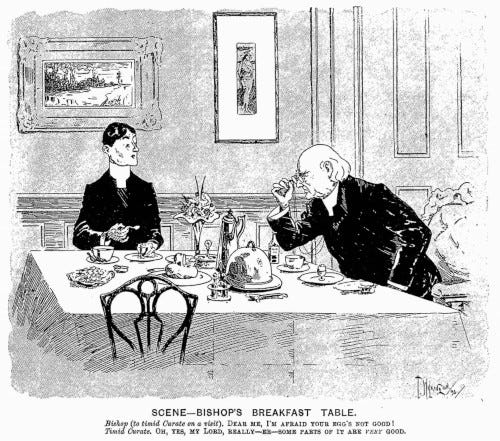
I have been longing to post this all week. I’m sure this is the perfect way to express the kind of relationship Anglicans are having with each other:
7-Listen to this beautiful hymn
And have a lovely day! If you’re up for it. I’m off to force people to speak French, whether they like it or not.
TWO!
I know I have posted many times as "an interested observer" of the ACNA that I don't understand how there are leaders and very vocal lay people who are advocating for things which a contrary to the foundational documents of the ACNA. But, at some time "corporate" has to withdraw a franchise when a location no longer adheres to the standards of the brand.
When David Roseberry suggests "that we all simmer down and let the Bishops do the work they need to do" I cannot exactly disagree.
But I am 100% sure, based on their recent actions, that the ACNA Bishops will get it wrong. They will not do the right and necessary things.
As a lay person, I have to simmer down and let this all play out. But I will bet any one of you reading this that it will NOT play out well for Traditional Anglicans. Everything will tend towards WO (and worse). Not hard to read these tea leaves!